

Culture & Collections
This disambiguation page serves as a collection of cultural activities, historical artifacts of importance, and other items. Here, you’ll find what Omneuttians do with their time, artifacts of all kinds from across the flow of time, and items that are used on a daily basis.
Activities
Arbae
Arbae is a team sport played across Omneutta with fairly simple rules that make it a game for all ages and species. The point of the game is to work with your team to place the ball in one of your opponent’s pockets as much as possible – games are either set to a specific scoring limit, within a time limit, or in the professional league, a combination.
Arbae is played in a sunken arena, so that slanted (or vertical) walls surround the playing area. There are six scoring pockets, and with only four players on each team, a team must strategize how to balance defending with scoring.
Teams control half of the scoring pockets, and which pockets a team controls are chosen by team captains pregame or otherwise ahead of time. The player with the ball cannot move aside from jumping straight up and down, and must throw or kick the ball to a teammate or attempt to score by getting the ball into a scoring pocket.
Okattaupos
Okattaupos is a game played with pieces on a circular board. It has many similarities to the real-life game of Chess. The game is for two players and is completed by scoring the most points. Points can be scored by removing your own pieces from the board or capturing your opponent’s.
Okattaupos’ origins have been lost to time, but the game is thought to be from around the Timekeeping Reset, in the century before or after. It is widely accepted that the game comes from the Kolegi systems of The Hilt though a small number of scholars believe it originated in the institutes of Parallelium.
The circular board is divided into rings and wedges, seen at right. Two players each control their own 14 pieces that are distinctly separate colours. There are four different categories of pieces.
- Fodders are the most numerous (9 per side) and can move one space in any direction.
- Runes can move four spaces either along its current ring or wedge, but not both.
- Seers can also move up to four spaces at once but are limited to a single direction—the direction is determined by the shape of the piece itself.
- Divines can move one space in any direction.
Aside from the placement of the Fodders around the remaining five (5) pieces, their positioning is not set. The object of Okattaupos is to win by scoring the most points. Each piece is worth an amount of points determined before the game—usually 1 for Fodders, 2 for Runes, 3 for Seers, 4 for the Divine. There are two ways to score, removing your own pieces by moving them into the central ring – or capturing your opponent’s pieces. A player can only move a piece into the central ring if the opponent does not have a piece the ring immediately outside, and a player can only capture an opponent’s piece from behind (from a ring outside).

Artifacts
Deity Cloak
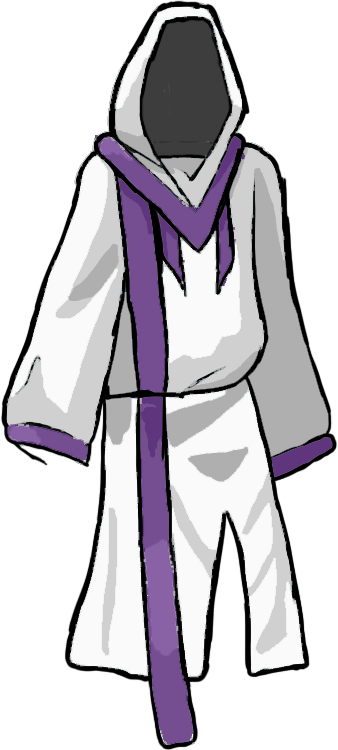
The Deity Cloaks, according to the Ontiba was a byproduct of the medallions created by Sham’ayn. The Deity of Trickery crafted eight medallions that would bind each Ontautt to their Shared Form. In the process, this binding also created the cloaks. According to some religions, the medallions were eventually considered unnecessary, and despite their removal some Deities chose to continue wearing the robes when in their Shared Form.
The robes are white and trimmed with a colour that represents its wearer. The trim can be seen on the edge of the hood around the head, both sleeves, and a long, thin banner hanging from the right shoulder. The medallion was hung beneath the hood, and by ribbons bearing the trim colour.
Read More:

Porrair’s Crown
Porrair’s crown is a fabled artifact said to be the headpiece of the Deity of knowledge. Said to be lost to Porrair with the advent of the Deity Cloaks limiting her power, the crown exists somewhere within Parallelium, though records of the crown’s existence and location are inconclusive at best.
The crown is said to act as a throne for the true monarch of the pori, and if a pori can sit on the throne and not be killed by the heat, all pori will know that this pori alone is the heir to Porrair.
Read More:


Items
Kaeoubo
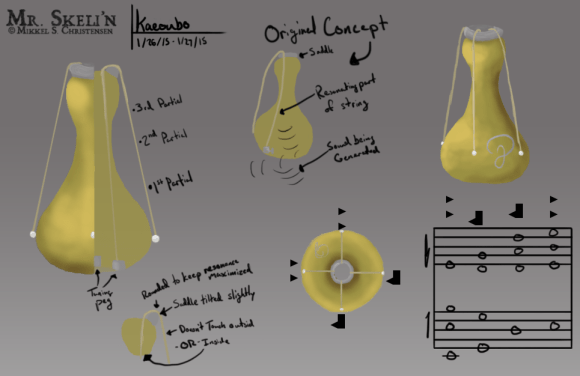
A strung gourd instrument, where the strings are secured inside and outside the instrument. The strings due to construction have been historically tuned to EGDE, though additional tunings have seen use recently.
On the outside of the instrument the strings are plucked and held in determinable positions to change the way the string vibrates inside the gourd to produce sounds. The saddle on the top of the instrument is rounded to maximize the amount of resonance that moves through the string from the outside of the instrument inward. Inside the instrument, where the strings are attached, are tuning pegs so that the notes that each string produces can be changed.
Lott
Lott (pl. and singular) is the main form of currency in Omneutta under the Omne-Lata-AdHocracy. They are often obtained from merchants or other Omneuttians in exchange for favors or goods. All five coins connect to display a design on one side; each coin has its own value on the opposite side in Ontrett.
Some Omneuttians prefer not to deal in in Lott and have economies based in bartering—select communities have a mix of bartered goods and monetary value in Lott. Lott are formed in casts of a durable metal and then coated with a thin layer of another material to add value. These rare materials are mined in Astran-space. The location of these mines are kept secret, to prevent pirates from disrupting the government’s monopoly on these rare metals.

Maps
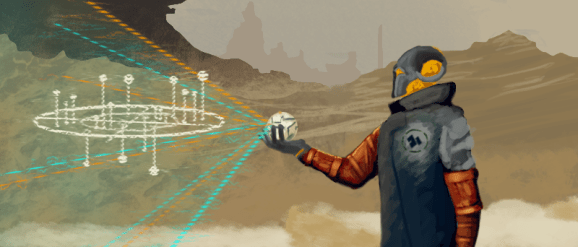
Maps in Omneutta have evolved over time, but for centuries have been produced by the enigmatic Wayfarers. Omneuttians are often in need of maps but are hard pressed to find or create their own, at least to the level of sophistication of Wayfarer maps. In many markets, you may be able to find chunks of map fabric, or if one is incredibly lucky, a spherical Map.
The most modern maps are spherical objects covered in raised plates and buttons. These buttons open the holographic projecting capabilities of the map, while plates direct the map on where or what to display though some maps reverse these features.
Most omneuttians however have seen a swath of map fabric in their lifetime, which have many of the projection capabilities as the sphere maps when laid horizontally or held vertically, but have a limited usage compared to the spheres, as they can only project the specific location mapped on the fabric, where spheres can be updated.

