
Explainers
This page contains information about the foundational knowledge of Omneutta and how it differs from the Earth experience. Here, you will find basic information on Celestial Bodies, Timekeeping, and some well-known festive Celebrations.
Celestial Bodies

There are two main types of celestial bodies in Omneutta: the Star-Planet, and the Planet-Star. As the nomenclature suggests, these two are quite similar, save for the star-core in the center of the landmasses.
In Omneutta, landmasses float or orbit around a star-core, and this makes most celestial bodies. The distinction between star-planet and planet-star is one of being habitable by mortals. For two celestial bodies with roughly the same circumference, one would be designated a star-planet if the star-core exceeds a percentage threshold that makes orbiting landmasses uninhabitable by mortals. Likewise, star-cores smaller than this threshold are designated as planet-stars and are habitable by mortals.
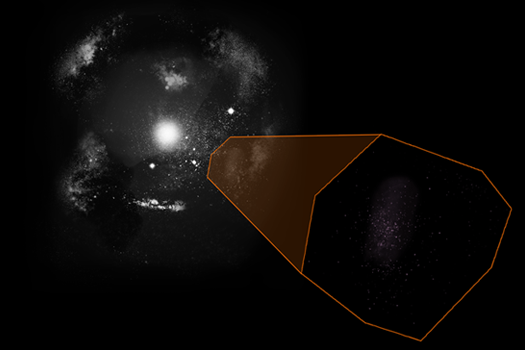
There are other kinds of celestial bodies, though they are less frequently encountered than a star-planet or planet-star. Of these, Continemos are more well-known, though very few are inhabitable. Continemos are floating landmasses with no star-core to orbit. Some may be caught in the gravity of distant star-planets or planet-stars, but well out of range of being considered part of that celestial body, though most float aimlessly through Omneutta, and are generally believed to be remnants of the Deity Wars.
Read More:
Timekeeping
Seconds are the most basic unit in Omneutta. This remains unchanged from Earth. However, in Omneutta, there are 100 seconds in a minute, and 100 minutes in an hour. Because of this, there are 8 hours in a day, generally divided into 2 hours each of dawn, day, dusk, and night.
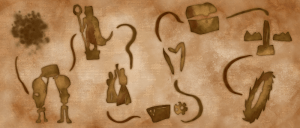
This unit of timekeeping also keeps the Earth year and the Omneuttian year roughly similar, with Omneutta using a leap year every 5th year to keep evenly equidistant orbits over this duration. The year is broken down into 10 months, and the week into 8 days, named after the Deities. Astepa was named after Aster and is considered a day of rest by all sentient species- most businesses are closed for the day. Ruepa is named after Extiru, Dauepa is named after Davoto, Keuepa is named after Haket, Porepa is named after Porrair, Qurepa is named after Quarrnyl, Hauepa is named after Sham’ayn and Taruepa is named after Taruthe.
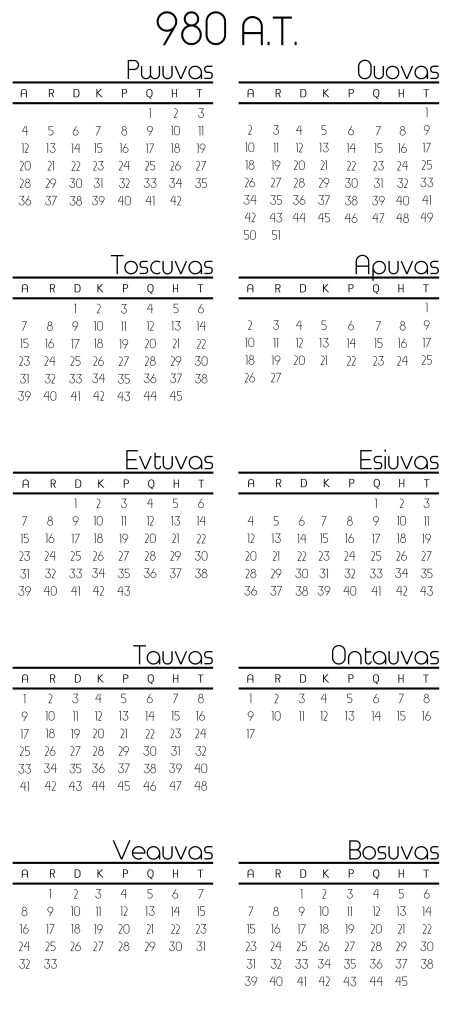
Ouovas, the 2nd month of the year is the longest, with 51 days. Evtuvas and Esiuvas are known as twin months, in the center of the year and both have 43 days. Following Tauvas, Ontauvas is the 8th month of the year and used to be a period of just longer than two weeks of constant worship of the Deities with no work, though this practice fell out of favour long ago.
Celebrations
There are a number of different holidays celebrated around Omneutta, some are local events, some are tied to specific sentient species, and some are celebrated generally:
- 1st of Pwuvas – Dawn’s Day
- 2nd Hauepa of Ouovas – Sham’ayn’s Day
- 2nd Taruepa of Ouvas – Niva
- Last Dauepa of Ouvas – Davoto’s Holy Day
- 5-6th of Toscuvas – Quarter Year Celebration
- 34th of Toscuvas – Day of the First Gate
- 17th of Apuvas – The Thawing
- 27th of Apuvas – Quarrnyl’s Day
- 1st Ruepa of Evtuvas – Extiru’s Day
- 2nd Porepa of Evtuvas – Porrair’s Day
- 31-34th of Evtuvas – Midyear Celebration
- 34th of Esiuvas – Rain Day
- 7th of Tauvas – Day of the Second Gate
- 44-45th of Tauvas – Quarter Year Celebration
- All Astepas of Ontauvas – Mandatory Days of Rest
- 40th of Bosuvas – Day of the Third Gate
- 44th of Bosuvas – End’s Eve
- 45th of Bosuvas – Saldov’y (Every 5 years)

Dawn’s Day
A festival celebrated across Omneutta that highlights each new year with relaxation, worship of the Ontautt, and other local rituals. Generally, it is observed as a day of rest – especially in light of the festivities the night before – and to prepare for the year ahead.
Originally the second day of the last Cylorok Rocyst together with the day that became End’s Eve. Its roots as the second day in what originally was a middle of the year celebration for the Turath have more or less been melded into its current iteration or forgotten entirely. Now, almost all Omneuttians across the Known Universe celebrate Dawn’s Day in their own unique cultural way, and these celebrations have changed over time. However, most celebrations involve flipping a large sandglass or other large symbolic item as End’s Eve ends and Dawn’s Day begins.
Cylorok Rocyst
Originally, the four Cylorok Rocyst were uniquely Turath celebrations. Now they are known as the 1/4-year, Mid-year, 3/4-year and New-year celebrations. Each celebration lasted two days, with the first day to look back on the season that was ending, and the second day to look toward the next season and prepare.
The celebration that is now the Mid-year celebration was at one point the end/beginning of the Turath year, and was spread over four days in some areas instead of two. The 1/4-year celebration was to celebrate the transition from cooling to cold seasons, mid-year was to celebrate cold to warming, 3/4-year celebrated warming to warm, and the now-new-year was to celebrate warm to cooling seasons.
Over time, as more cultures began using the Omneuttian calendar agreed on by O.L.A.H., the celebrations were moved slightly to line up to be equidistant on the calendar itself. While the many Turath still observe the four Cylorok Rocyst, the festivities that other Omneuttians have spread back to The Hilt. Universe-wide, the two quarter-year celebrations pale in comparison to the festivities of the more recognized Mid- and New-year celebrations. Currently, the New-year celebration is recognized by O.L.A.H. as two separate holidays, End’s Eve and Dawn’s Day, while the Mid-year celebration is in some parts celebrated for four days.

Days of the Gates
Perhaps the oldest holiday or set of holidays in Omneutta, the Days of the Gates are directly related to the events of the Kel. According to Book 4 of the Ontiba, the abilities of the gates that lie somewhere within Golden Deep transfer more readily to Kettlah on this day, due to the energy of Ibausec being at its closest or furthest on the first and second days.
Less of a celebration and more a series of observances, Kettlah are expected to travel back to their birthplace, if financially and physically able. Those who cannot observe a silent day without movement in meditation. Whether a ket can make it to Vale Reef or not, most typically fast from first light of the day to first light of the following day. Those who can make it back to their home tribe make a much shorter pilgrimage to their tribe’s gate which for the day acts as one of the two gates in the Golden Deep.
The Day of the Third Gate is observed by a smaller portion of Kettlah tribes, as there is not a third gate mentioned in the Kel. This hypothetical Third Gate is that of the present, and would in essence enable one to exist somewhere else at the same time. With the first two days being set based on the relationship between the physical locations of the Golden Deep and Ibauesc on Astran, the Day of the Third Gate was set so that all three days would be equidistant.
The Thawing
There are a few ways to celebrate The Thawing that are found across Pale Shores. In addition to celebrations honouring Davoto, Lieyos is brought into public spaces in an attempt to melt it. To go along with this test of heritage, many Avocs will perform Kaeoubo songs, complete with percussion and other instruments, as well as most water-side communities holding sand sculpture contests, and fishing competitions
It is not clear how The Thawing was celebrated, or even when it was first celebrated, as the first recorded celebration makes mention of the traditions. Unlike other single-species holidays, there is no clear mention of the event(s) celebrated in The Ontiba or specifically the Dav.


End’s Eve
End’s Eve was originally the first day of the middle Cylorok Rocyst together with the day that became Dawn’s Day. This celebration marked the middle of the year for the Turath calendar. However, the holiday this is now End’s Eve is likely an amalgamation of several cultural end-of-year festivals which may not have always been celebrated at this point in the year, but after the adoption of the Omneuttian Calendar by O.L.A.H., several festivals seemed to have been moved onto this date whose practices are now observed outside of their original communities.
One aspect of the holiday that takes many forms is whether or not the Deities will allow the Sentient Species another year, which is observed by rituals of penance, public (though sometimes in jest) displays of Deity-fearing, or gratitude to the Eight for allowing the current year to have transpired fully. Another aspect is something to do with those who have passed away in the previous year, whether this is in remembrance of the life they led or to express grief at their loss. These rituals take many forms including but not limited to dressing up in deceased friends’ or relatives’ clothes and acting like them for the day, visiting where remains are stored (in applicable cultures), and decorating the exterior of a dwelling with their belongings or other mementos.
Saldov’y
Situated between End’s Eve and Dawn’s Day every five years, it is not a time to look back or forward, but to be grateful to those in the present, and to spread joy, wealth, and above all balance. There are three main celebrations that are observed Saldov’y. The first is gift giving and happens during the light hours of the day. The second celebration consists of an individual lighting and placing a candle by a tree without leaves as the light of Astran fades at the end of the day. The third and final portion occurs once the light of Astran has faded, where entire communities will cook and eat a large feast together.
The traditions of Saldov’y themselves predate the holiday, coming from an amalgamation of Turath holidays around the year or that were held non-annually. When the O.L.A.H. was formed late in the first century A.T., the early Turath government decided to combine several local holidays into a singular Turath holiday celebrated once every five years on the leap day.

Read More:
Religion
The de facto religious belief of most Omneuttians is called Uatti and holds that Aster and the other seven Deities created Omneutta and the Sentient Species. Uatti is the underlying basis of all religions around Omneutta.
- The Book of Aster is true
- Aster created Omneutta
- Aster created the other seven Deities
There are some groups and individuals that deny the existence of the Ontautt, and doubt the validity or truth of the Ontiba. There are many reasons why Omneuttians do not believe in the Deities.
- Citing contradictions in the Ontiba, primarily between books 2-8
- Perceived lack of contemporary influence of the Deities
- Belief of no need for a higher power, as phenomena can be explained by the growing knowledge of the natural sciences
Read More:
Efteta
While avocs have been around centuries—hundreds of years before the Timekeeping Reset—much of their worship practices have been documented exclusively through oral tradition. These histories and rituals have been passed down by rote, creating rich diversity in each denomination.
The Dav is the foundational text of Efteta, with around ten books considered to be part of the religion’s canon. Some denominations have more or less books, but none have fewer than seven. No denominations hold any books written after the Timekeeping Reset, as any contact with Davoto after that point is considered heretical or blasphemous.
Though there are differences across and within denominations, overall avocs hold their ancestral relationship with Davoto in high esteem. In some communities having a clearer or more established bloodline is considered more holy, and these clans have more power in the area. Generally some form of ritualistic or repetitive worship is considered necessary to maintain the relationship.
There are three main denominations of Efteta with three very different takes on worshiping the Deity of Death. Two—Grenavoc and Alieravoc—are in relative opposition on how to read and interpret the events of the Dav, with the former taking a more literal or straight approach and the later taking a more metaphorical approach. A third large denomination called Driovoc has both literal and metaphorical stances of various books, but is differentiated by a central tenant that seeks to promote a “healthy” fear of Davoto among avocs.
Read More:


Remiges
At its core, Remiges stems from the choices made by Niu and Haket concerning what to do over the knowledge of the future. Remiges is best described as a set of philosophical practices and questions considered by most kets.
The most widely practiced observance is the meditation, a state similar to sleep where a majority of the body shuts down to leave the brain and spirit functioning in their fullest capacity. It usually takes decades to master the meditation, and is often being honed by the time a ket returns to their tribe as early as their 60s. The state of meditation is a goal for all kets, and rare few are able to achieve visions of the future in this state. Kets who are able to relive ancestral memories of mortals they encounter enter a similar state to use the ability. Most kets who achieve a true state of meditation will slightly levitate, though it is uncommon to be more than a few centimeters off the ground.
As all kets are assumed to be practitioners of the Remiges beliefs and non-kets do not share the beliefs or abilities, there is no word for those who do or do not ascribe to the system. However like many other religions, there are divisions or denominations between kets over disagreements that largely stem from different interpretations of the Kel and in some cases disagreements over the legitimacy of entire sections.