
The Outcropping
Sub-arid at best, The Outcropping has little in the way of vegetation and moisture but life here has adapted. Most if The Outcropping is covered by large deserts, with expanses of short, dry grasslands between. Xiruen-Space is notable for the rock structures in which the Xiruen make their homes—many of these “rocks” are actually hardened forms of vegitation that grow slowly towards light sources, often at odd angles.
See Also:
Regions

Pan Arbnhap
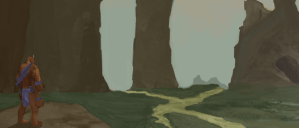
Planet-Stars in Pan Arbnhap feature the harsh deserts The Outcropping is known for as well as basins that run with water from thawing ice, and a gradient of climates between. The majority of Pan Arbnhap is between these two extremes, with both flowing and standing water present on nearly every Planet-Star in the region. The climate of Pan Arbnhap is classified as a Hot Binary, where roughly half of the year is a hot season, and the other half being a cold season. Because it is a Hot Binary, this means that the hotter season tends to be far more harsh than the cold season.
Geographically the continents of Planet-Stars are mostly similar in that they generally form large basins—though these are not always the entire continent—where water collects. In locales that are furthest from Astran’s light, and geography furthest from the planet-star’s star-core, this water can freeze, creating snow, ice, and at times glaciers.
Read More:
Sentii
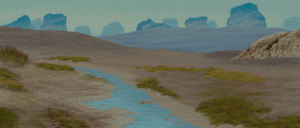
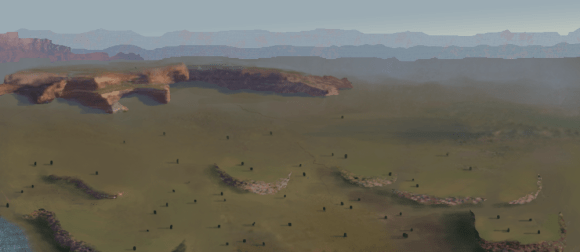
While not as moisture-laden as Pan Arbnhap, Sentii is prone to quick torrential downpours to contrast to its well known oppressive heat. Sentii lacks one of the most notable features of The Outcropping, the tall rock structures that Xiruen often make their dwellings in. Instead, the geography is dominated by rolling hills that turn into cliff faces. The xiruens who manage to live in Sentii are those who can adapt to life in the deep cave-like dwellings that provide the only cover from the oppressive heat, occasional torrential rain, or other threats Sentii offers to its inhabitants. Similar to other regions, at its most inhabitable Sentii is a Binary climate; harsher areas of the region have little-to-no rainfall where other areas have their year split between an arid cold season and a hot torrential season.
After it gets hot enough to evaporate any moisture in the soils and grasses across the flatlands, a near-daily cycle begins of the moisture evaporating to meet the colder air of the upper-atmosphere before falling back down onto parched land. During this half of the year, what little moisture that can be absorbed in the ground and by plants is done during the darker portion of the day before evaporating as the light of Astran comes over the horizon, then falling back down into standing puddles by the time of last light. This phenomenon creates small and ever-changing lakes across the local group, to which both plants and animals are well adapted.
Read More:

Xusoigar
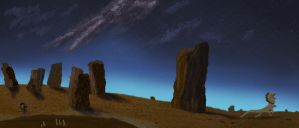
Geographically, Xusoigar is what comes to mind when many Omneuttians think of The Outcropping. With its towering, physics-defying slanted and curved rock-structures, this local group is the most visually distinct. Most of the planet-stars in the area are covered with shifting sands so that the rock-structures are the only point of geographic reference, and for this reason maps of planet-stars in this region are hard to come by.
Some of, if not the most, hostile living conditions in The Known Universe, Xusoigar is home to a hardy bunch of xiruens, wildlife, and flora. Unlike the other two local groups, there is less than 10 cm (4”) of rainfall over the course of the year on average throughout the local group. All life in the area has developed alternative means to locate and keep moisture.

